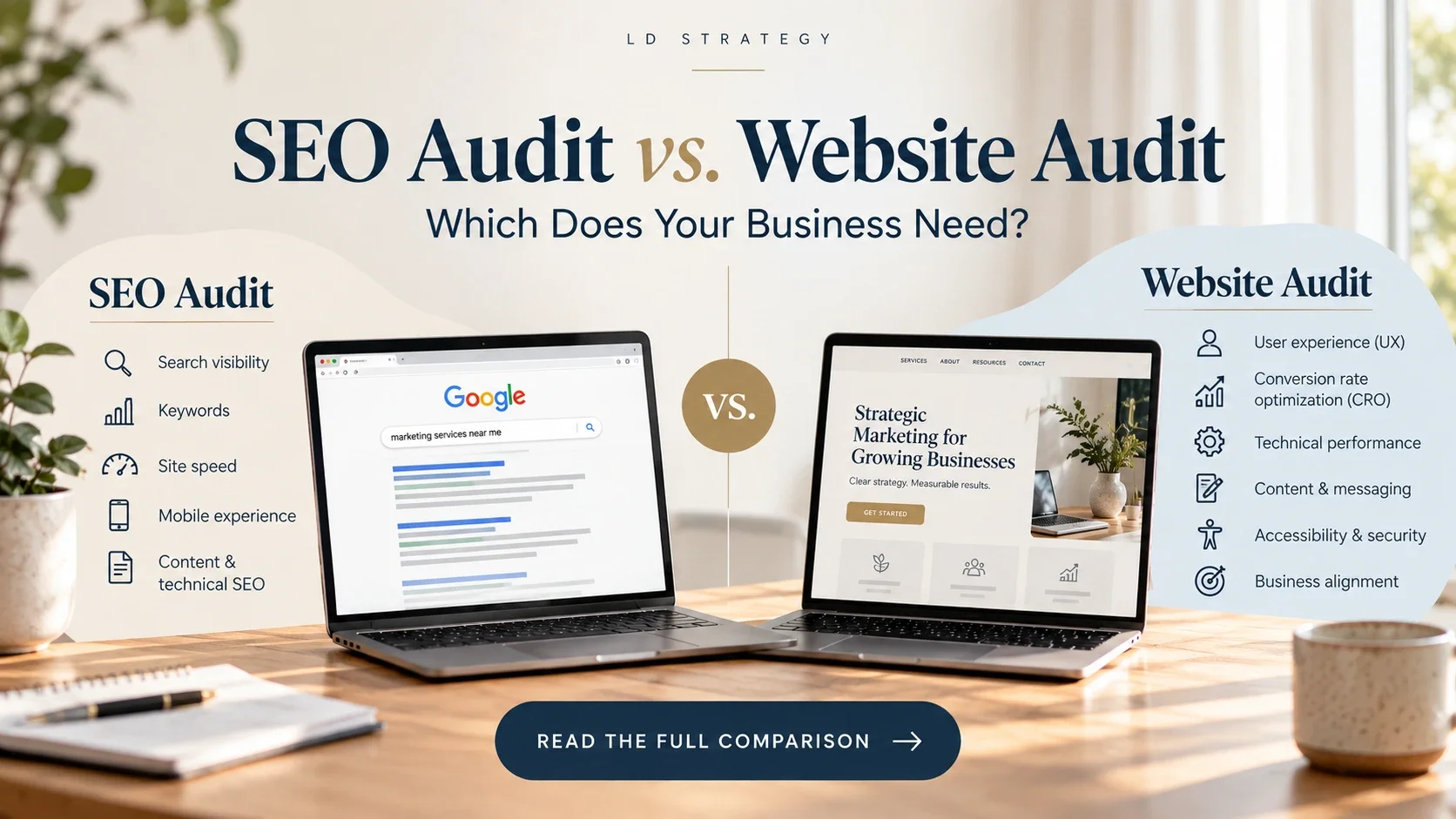
Not sure why your website isn't bringing in more customers? Understanding the difference between an SEO audit and a full website audit can help you figure out what's going wrong and where to focus your efforts.
Your website looks good, but something isn't working.
Maybe you're not getting enough visitors. Maybe people are finding your website but aren't reaching out or making purchases. Or maybe you know your website could perform better, but you're not sure where to start.
That's where a website audit comes in.
But not all audits look at the same things.
An SEO audit focuses on helping people find your website through search engines like Google.
A full website audit looks at the bigger picture, including how easy your website is to use and whether people take the actions you want them to.
So, which one does your business need?
Let's break it down.
What Is an SEO Audit?
An SEO audit reviews how well your website performs in search engines like Google.
Its main purpose is to identify problems that might be preventing your website from appearing in relevant search results.
For example, let's say you own a landscaping business. When someone searches for "landscaping services near me," you want your business to show up. If your website isn't showing up in those searches, an SEO audit can help you understand why.
An SEO audit typically looks at:
Search visibility: Can Google find and understand your website?
Keywords: Are you using the words and phrases your potential customers are actually searching for?
Website speed: Are slow-loading pages affecting your search performance?
Mobile experience: Does your website work properly on phones and tablets?
Website content: Do your pages clearly explain your products or services and answer relevant questions?
Technical SEO: Are there behind-the-scenes issues preventing search engines from accessing your pages?
The result is a clearer understanding of what's holding back your organic traffic (visitors from unpaid search results) and what improvements to prioritize.
What an SEO Audit Doesn't Tell You
Here's an important distinction: Getting people to your website is only half the battle.
An SEO audit can help identify why people aren't finding you, but it generally won't explain why visitors leave without purchasing, filling out a form, or contacting your business.
That's where a more comprehensive website audit becomes valuable.
What Is a Full Website Audit?
A full website audit looks at how well your entire website is working for both your business and your customers.
It includes SEO, but goes further by examining the experience people have once they arrive.
Think of it this way: SEO helps bring people through the door. Website optimization helps make sure they have a good experience once they're inside.
A full website audit typically reviews five key areas:
Technical Performance: Does your website load quickly, function properly, and work across devices?
On-Site SEO: Can search engines find your website, and is your content optimized for relevant searches?
User Experience (UX) & Design: Is your website easy to navigate? Can visitors quickly find what they need?
Accessibility: Can people with different abilities comfortably access and use your website?
Content: Is your messaging clear, helpful, and relevant to your audience?
A full website audit also covers conversion rate optimization (CRO), which means improving your website so more visitors become customers, leads, or subscribers.
For example, your website might be attracting hundreds of visitors each week. But if your contact button is hard to find, your services aren't clear, or your mobile layout is frustrating, you could be losing potential business.
A full audit helps identify those missed opportunities.
SEO Audit vs. Full Website Audit: What's the Difference?
SEO Audit:
Focuses on search engine visibility
Helps improve organic traffic
Reviews keywords, content, and technical SEO
Best for: when people aren't finding your site
——————————-
Full Website Audit:
Focuses on overall website performance
Helps improve traffic and conversions
Reviews SEO, speed, design, usability, accessibility, and content
Best for: when your site isn't generating the results you want
Both can be valuable. The right choice depends on the problem you're trying to solve.
How Do You Know Which Website Audit You Need?
You don't need to be a website expert to recognize when something isn't working.
Here are a few common situations to help you decide.
1. People Aren't Finding Your Website
Consider an SEO audit.
If your website rarely appears in Google searches, your organic traffic has dropped, or competitors consistently appear ahead of you, an SEO audit is a logical place to start.
It can help identify problems with your keywords, content, or technical SEO that may be limiting your visibility.
2. You're Getting Visitors, but Not Enough Customers
Consider a full website audit.
If people are visiting your website but aren't contacting you, booking appointments, or making purchases, the issue may be with the experience you're providing.
Confusing navigation, unclear messaging, slow pages, and difficult contact forms can all discourage visitors from taking the next step.
A full website audit can help pinpoint where those opportunities are being lost.
3. Your Website Feels Outdated or Difficult to Use
Consider a full website audit.
Maybe your website looks fine on a computer but is frustrating to use on a phone. Or your business has evolved, but your website hasn't kept up.
Before investing in a website redesign, it's worth understanding what's working and what isn't.
An audit can help you make informed updates rather than changing things simply for the sake of a new look.
4. You're Not Sure What's Wrong
Start with a full website audit.
This is more common than you might think.
Many business owners know their website should be doing more, but they don't have the time or technical background to figure out why.
A comprehensive review can uncover issues you may not have considered, from poor search visibility to small design frustrations that are costing you potential customers.
Can You Audit Your Own Website?
Yes, at least to a certain extent.
There are free tools that can help you get a better understanding of how your website is performing.
For example:
Google Search Console helps you understand how your website appears in Google Search.
Google Analytics (GA4) shows how people find and interact with your website.
Google PageSpeed Insights highlights website speed and performance issues.
These tools can provide valuable information, but understanding what the data means and which changes will have the greatest impact can be more challenging.
That's where a professional website audit can help.
Rather than handing you a long list of technical issues, a useful audit should explain what's happening, why it matters, and what to prioritize based on your business goals.
Is a Website Audit Worth the Investment?
If your website plays a role in attracting customers, generating leads, or driving sales, understanding how well it's performing is a worthwhile investment.
The goal isn't to identify every small imperfection.
It's to focus on the improvements that can make the biggest difference.
A good website audit should leave you with three things:
Clarity: A better understanding of what's working and what's holding your website back.
Priorities: A clear picture of which issues deserve attention first.
A plan: Practical recommendations you can act on without feeling overwhelmed.
And importantly, it can help you avoid spending money on website changes that don't address the real problem.
The Bottom Line: Start With the Right Questions
You don't necessarily need a completely new website to get better results.
Sometimes the biggest improvements come from making your existing website faster, easier to navigate, more visible in search results, or clearer in how it communicates your services.
If your main challenge is getting found online, an SEO audit may be enough.
If you're struggling with conversions, usability, or overall website performance, a full website audit can provide a more complete picture.
At LD Strategy, we believe website optimization should feel approachable, not overwhelming. Our Digital Growth Audits are designed to help business owners understand what's working, identify opportunities, and create a clear path forward.
Not sure where to begin?
Explore our Digital Growth Audit services and learn how a fresh perspective can help your website work harder for your business.