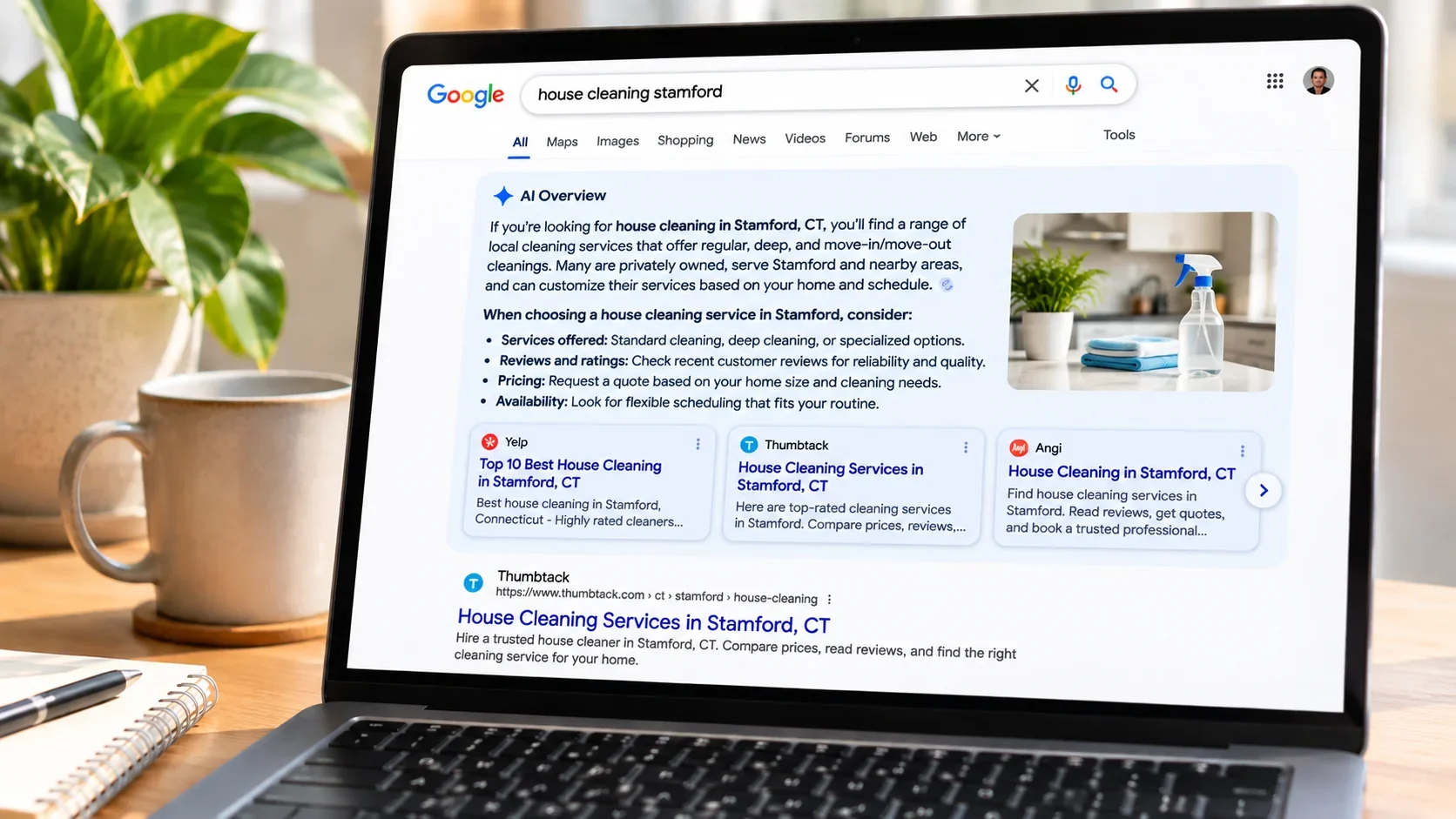
Search is changing. Instead of scrolling through a list of websites, people can now get answers directly from Google through AI Overviews.
For businesses, this creates a new question: How do you get your website to appear in Google AI Overviews?
The answer may be simpler than you think.
You don't need to completely change your SEO strategy or fill your website with keywords. Many practices that support traditional SEO also help prepare your website for AI-powered search.
The key is having a strong technical foundation paired with content that clearly answers your customers' questions.
At LD Strategy, we approach AI search optimization with one guiding principle: Your website should be easy for both search engines and real people to understand.
Here's where to start.
What Are Google AI Overviews?
Google AI Overviews are AI-generated summaries that appear in search results for certain questions. They bring together information from different sources to help users find answers quickly.
These summaries may include links to websites that support the information presented.
For businesses, appearing as a supporting source creates another opportunity to reach potential customers.
However, there is no guaranteed way to secure a placement.
Google's guidance confirms that traditional SEO best practices remain relevant for AI Overviews. This means improving your existing website is often the best place to begin.
1. Build a Strong Technical SEO Foundation
Before updating your content, make sure your website is technically sound.
Even helpful content may struggle to gain visibility if search engines cannot access or properly process it.
Many of the same practices that improve traditional search visibility also support AI search visibility. If you're getting started, our guide on how to optimize your website for Google Search covers practical steps to strengthen your SEO foundation.
Improve Website Speed and Mobile Performance
A slow website creates a frustrating experience for visitors.
Start by reviewing your website's performance using Google PageSpeed Insights.
Focus on:
Compressing large images.
Removing unnecessary scripts and plugins.
Improving mobile layouts.
Reducing elements that delay page loading.
Checking that important pages are indexed.
Website speed alone won't guarantee AI Overview visibility, but it contributes to a better user experience.
Use Proper Heading Structures
Your headings should organize content logically.
For example, a website design page might use:
H1: Website Design Services
H2: Our Website Design Process
H3: Discovery and Planning
H2: Frequently Asked Questions
H3: How Long Does a Website Redesign Take?
Clear headings help visitors navigate information and communicate how different topics relate to one another.
Avoid choosing headings solely based on appearance. Their purpose is to organize your content.
What About llms.txt?
You may have heard recommendations to add an llms.txt file to your website.
This proposed format helps AI systems that choose to support it find important website content.
However, Google has stated that it does not use llms.txt for Google Search or AI Overviews.
While the file may be worth exploring for other AI applications, improving website performance, crawlability, and content should take priority.
2. Answer Your Customers' Questions Directly

One of the biggest opportunities I see when reviewing websites is improving how businesses communicate what they do.
Many websites contain useful information, but it's buried beneath technical terminology and complicated explanations.
This creates a problem.
The people searching for your business may not understand the language you use every day.
Existing customers are often familiar with your services. New customers searching Google or AI tools may be encountering your business for the first time.
Your content needs to speak their language.
Write for Your Customers, Not Your Industry
Imagine someone visiting a financial services website.
They may need help understanding expenses, organizing their books, or preparing for tax season.
If every service uses specialized accounting terminology, that visitor may struggle to understand whether the business can help.
Instead, consider answering questions such as:
What does a bookkeeper do?
How often should I update my financial records?
What's the difference between bookkeeping and accounting?
How can bookkeeping help me prepare for tax season?
These questions reflect how someone unfamiliar with the industry might search.
You don't need to eliminate technical terms entirely. You need to explain them clearly.
Put the Answer First
When answering a question, provide the answer before adding background information.
For example:
How long does a website redesign take?
A typical website redesign takes four to six weeks, depending on the number of pages, design changes, and time needed for feedback and approvals.
Then explain what influences the timeline.
This structure helps readers find answers quickly and makes the main information easier to identify.
3. Review and Improve Your FAQs
If you're looking for a practical place to begin, I recommend reviewing your frequently asked questions.
Thorough FAQs help potential customers understand your services before reaching out.
But simply adding questions isn't enough. Your answers need to be helpful.
Identify Questions Customers Actually Ask
Think about your conversations with prospective clients.
What do they ask during consultations? What do they misunderstand? What concerns prevent them from moving forward?
These are excellent starting points for FAQs.
For example, a website design business might address:
How much does a new website cost?
How long does a website redesign take?
Will my existing site remain live?
Can you help with website content?
What happens after launch?
Answer each question directly rather than relying on vague responses that tell visitors to contact you.
Get an Outside Perspective
One of my favorite recommendations is also one of the simplest.
Ask someone unfamiliar with your industry to review your website.
Have them explain what your business does, identify confusing phrases, and point out unanswered questions.
As business owners, we become so familiar with industry terminology that we forget it isn't common knowledge.
An outside perspective can uncover opportunities that are difficult to recognize yourself.
4. Improve Content Readability
Another step I recommend is running your content through a readability analyzer.
Tools using the Flesch Reading Ease scale can help identify overly complicated sentences and terminology.
This doesn't mean every website should have the same reading level. Your language should match your audience.
Make Your Content Easier to Understand

Review your important service pages and blog posts.
Look for ways to:
Shorten long sentences.
Break up large paragraphs.
Replace unnecessary jargon.
Explain unfamiliar terms.
Use descriptive headings.
Remove repetitive information.
For example, instead of writing:
"Our comprehensive financial reconciliation solutions facilitate enhanced operational efficiencies."
Try:
"We help keep your financial records accurate and organized so you can spend less time managing your books."
Both statements communicate expertise, but the second is more approachable.
Readability scores aren't Google AI Overview ranking factors. They're tools that help you communicate more effectively.
The goal isn't a perfect score. It's making sure your customers understand your content.
5. Strengthen Your Internal Linking
Internal linking is another important part of website optimization.
Internal links connect related pages, helping visitors discover more information and search engines understand your website's structure.
For example, someone reading about wellness practices may also want to understand how nutrition fits into the process.
You could naturally link from your wellness services page to your nutrition services page.
An article about healthy lifestyle practices could link to your nutritional support services.
These connections help visitors explore topics without starting another search.
Avoid adding links simply to increase their number. Each link should provide relevant information that adds value to the visitor's experience.
6. A Real Example: Simplifying a Beauty & Wellness Website
Recently, we analyzed an existing spa consumer packaged goods website that relied heavily on industry-specific terminology.
Although the business had valuable expertise, much of the content didn't directly answer the questions an everyday customer might ask.
The issue wasn't necessarily a lack of information. It was how that information was presented.
What We Changed
We reframed the website's questions and answers from the customer's perspective.
Rather than focusing on insider terminology, we made the content easier to understand.
We prioritized explaining:
What services the business provided.
How those services helped customers.
Which problems the business could solve.
What someone needed to know before getting started.
What We Observed
Following these updates, we saw improved clarity and search rankings.
While we didn't separately measure AI Overview appearances for this project, it illustrates an important principle.
Sometimes improving search visibility doesn't require producing more content.
It requires making existing content easier to understand and more relevant to customers.
7. Avoid Keyword Stuffing and Preserve Your Brand Voice
When businesses begin optimizing for AI search, their first reaction is often to add more keywords.
But repeating keywords unnaturally can hurt readability and may violate Google's spam policies.
The goal isn't to use more keywords. It's to use the right ones. Understanding how to find the best keywords for your website can help you identify the language your customers actually use without sacrificing your brand voice.
There's also a fine balance between learning from competitors and losing your brand identity.
Competitor research can reveal useful topics, unanswered questions, and content gaps. However, copying the same language and structure can make your business sound generic.
Your website should reflect your experience, personality, and approach.
Share examples from your work. Explain why you recommend certain solutions. Discuss mistakes you've observed.
These details make your content more valuable than generic explanations.
Use keywords naturally, but don't sacrifice your voice to include them.
8. How to Measure AI Overview Visibility
Once you've made improvements, monitor how your website performs.
Google Search Console is a useful starting point.
Review:
Organic search impressions and clicks.
Changes in search rankings.
Performance of updated service pages.
Traffic and engagement.
Leads generated through organic search.
You can also manually check relevant searches to see whether your website appears among AI Overview supporting links.
Keep in mind that results can change based on location, search, and time.
Google includes AI Overview performance within its broader Search Console reporting rather than providing a dedicated AI Overview report.
Improved rankings don't automatically mean you're appearing in AI Overviews.
The bigger goal is attracting relevant visitors who understand your services and are more likely to become customers.
Where Should You Start?
If you want to improve your website's AI search visibility without investing in a complete overhaul, prioritize these five steps:
Review technical SEO. Check speed, mobile performance, indexing, and heading structure.
Improve FAQs. Answer real customer questions clearly and directly.
Get outside feedback. Ask someone unfamiliar with your industry to identify confusing content.
Improve readability and internal linking. Simplify language and connect related pages.
Measure and refine. Monitor search performance and continue improving based on customer needs.
These improvements support your broader SEO strategy while helping prepare your website for AI-powered search.
Final Thoughts: Focus on Clarity Before Complexity
AI search optimization can sound overwhelming, especially with new terminology and recommendations appearing constantly.
But businesses don't need to chase every trend or completely reinvent their websites.
In my experience, some of the most effective improvements are also the most practical.
Make sure your website works properly. Answer customer questions. Simplify confusing language. Connect related content.
And most importantly, retain the personality and expertise that make your business unique.
If someone unfamiliar with your industry can visit your website and clearly understand what you do, who you help, and why it matters, you're moving in the right direction.
At LD Strategy, we help businesses improve website performance, SEO, AI search visibility, and user experience.
If you're unsure where to begin, explore our Website Audit Services or SEO Services to identify opportunities and prioritize improvements.
Because effective digital growth shouldn't be complicated. It should be clear, practical, and built around your customers.